What is MCI?
This is a translation of an article written by its founder Valerie Clertan and originally published by COPMED. Used with permission.
We Are Multidimensional Beings
When we face difficulties – whether internal (physical and/or psychological distress) or external (relational, social, professional, etc.) - sometimes it's enough to provide solutions in the present context for things to return to normal. But sometimes this isn't enough, and we see the problem recur and even become established without any apparent cause.
The next step is to check if this event might be connected to other similar events in our past, like beads stringing together to form a bracelet. In fact, the current event is often just a trigger, another echo of an underlying dysfunction.
Back pain, for example, can result from poor posture, a fall or accident, or sometimes occur without any observable cause. For the body, it's recorded as another layer in the "back pain" category. Removing this last layer may not be enough to resolve the entire issue... which is why it will resurface at the next opportunity.
However, if we consider the entire history of this back pain, we'll find traces, buried in cellular memory, of similar events conducive to reactivating this symptom. There is an original impact that silently emits traumatic information, ready to resurge at the slightest opportunity to remind us of its "presence"... We must therefore trace the original trauma, then modify what has been engrained (inscribed in our organism), so that this part of the body can find its way back to self-regulation and return to optimal functionality.
In addition to their personal experience that may have led to back pain, the person may have genetically inherited a vulnerability in this area of the body - while other family members may have inherited other issues that their ancestors already suffered from (known or unknown): one inheriting the paternal grandfather's alcohol problem, another inheriting the maternal grandmother's tendency toward melancholy, etc.
This is observable in countless areas. Our ancestors had no means to repair their traumas; they lived and died with them. The methods that allow us to break these chains of transmission are extremely recent, and the approach itself is still (too) uncommon.
This explains why nowadays, clients often carry numerous transgenerational burdens. These inherited patterns are heavy because they've accumulated over generations without previous opportunity for relief. There are all the tragic events that no one could express during their lifetime, often due to taboos present at the time (family taboos or those of religious, ethnic, social, or cultural origin), creating heavy unspoken issues, family secrets, fears, shame, and guilt...
And when we understand that "what isn't expressed gets impressed," we better understand where all sorts of manifestations without apparent valid reason come from.
Experience shows that information comes from much deeper transmission levels than our conscious mind can detect or even suspect. Therefore, it becomes necessary to investigate to trace the original traumatic context (age, circumstances, protagonists, etc.) as well as how it was experienced and recorded: the feelings, specific emotions attached to this event, beliefs that were established around it, behaviors that resulted...
This complex set of data is imprinted at the cellular level of the organism, to be preserved and transmitted to descendants, so that the experience of the elders benefits the newcomers. The body continues to emit the same stress for generations, like a warning message sent to descendants.
"The method approaches each human being in their specificity, but also in their totality..."
It is partly thanks to this phenomenon of cellular recording of existential experiences that species survive and perpetuate themselves since the dawn of time.
But these cellular data need to be revisited to be updated and made appropriate to our current life. For example, there's no point in retaining the trace and aftereffects of periods of famine when food is abundant today... For cells, time doesn't exist. Therefore, the age of stored information doesn't prevent access to it. Of course, the more we tackle the root of difficulties, the more the repairs are inscribed in deep layers, and the more lasting they become.
The benefit of these "updates" is obvious for the person consulting but it's also beneficial for their descendants, since MCI works at the level of cellular memories.
The information "I have back pain every time" (or "I'm afraid every time" or "I lose sleep every time," etc.) will simply be deactivated, thus breaking the chains of genetic transmission.
A problem is a solution seeking itself. It's up to us to help it emerge! But for this, we must look in the right place, where the shift can happen, where transmutation can take place.
WHAT IS MCI?
MCI is a psycho-physical healing method, specifically created to optimize therapeutic results for health professionals and helping relationship practitioners.
Its complete name is "Méthode Causale Intégrative" (Integrative Causal Method). "Method" because it is a complete discipline, structured and coherent. "Causal" because it systematically connects presented symptoms to their generating causes, to better unravel their origin. And "Integrative" because the method was developed to be integrated into the regular practice of very different practitioners, providing them with cross-cutting skills in accompanying their patients/clients.
HOW DOES AN MCI SESSION WORK?
The first part is dedicated to a verbal exchange, to fully understand the situation and request of the present person. If they mention pathologies that fall within the medical domain, we verify that they have complete medical follow-up.
The rest of the session can take place lying down, sitting, or standing, according to the practitioner's preference. From there, the body guides the session through muscle testing:
First, to establish an assessment of dysfunctions and indicate how they connect between different levels (a fear, for example, can come from either a personal or transgenerational blockage, and have physiological repercussions through energy circuits).
Then to conduct necessary investigations (tracing the origin of the blockage and its context, making sense of what manifests and creates disturbances) as well as selecting appropriate interventions (balancing) to perform.
Finally, to evaluate the impact of corrections made in relation to the initial assessment. Muscle testing provides real-time bodily feedback.
The body is a true living barometer, able to provide indications about what weakens it but also what strengthens it. By dialoguing with it in both a precise and subtle way, MCI allows for customized support.
The emphasis is on awareness, through the transparency of information that emerges from cellular unconscious archives, and the connections that can be established with the current issue of the person consulting.
All this takes place in the form of ongoing interaction between practitioner and client; an MCI session is teamwork!
TOOLS OFFERED
The MCI toolbox was specifically designed so that healthcare professionals from all backgrounds can select what seems appropriate for their regular practice. It is multiple and varied, but above all very adaptable to each profession's specificities.
Available balancing techniques range from acupressure (or digitopressure) to NLP, Enneagram, including EFT (Emotional Freedom Technique) or even EMDR (in cases of significant trauma), corrections aimed at restoring optimal bodily mobility, visualizations accompanied by harmonizing phrases from Family Constellations, concrete or symbolic reparative acts, etc.
Emotional supports are offered: flower essences (Bach flowers or others), mineral essences, essential oils in aromatherapy, crystals...
Qualified prescribers (naturopaths for example) can supplement with natural health products to support the organism in its recovery when needed. Muscle testing will allow them to best adjust their prescription taking into account each organism's specificity.
WHO IS MCI FOR?
Everyone, without exception, from conception onward. From age 5, children can attend sessions (accompanied by a parent of course); for younger ones, the parent comes to the session and serves as a relay through the transfer technique.
This transfer technique offers the advantage of being able to consult during pregnancy (in case of difficulties for both mother and baby).
People with disabilities, handicaps, or autism can also benefit from the method's contributions through this means. In all cases where the body is the best, or even the only way to express oneself, MCI provides privileged help. Most often it acts as a complement to other approaches more focused on physiology or psychology. Its field of action is psychosomatics as a whole.
SOME EXAMPLES ENCOUNTERED DURING SESSIONS
Intrauterine Life and Its Events
I had been following a woman in her thirties, like many in our time: brilliant, hyperactive, passionate about her profession and invested in her career. She wanted to conceive a baby naturally, which was taking time.
She eventually became pregnant and the pregnancy was going well, until the last moment when she learned that her baby was in breech position and without turning, vaginal delivery would be compromised.
She came back to consult me about this, and as soon as the body was questioned, it was the baby who "took the microphone": he didn't want to leave the womb because he feared that once outside, thus physically separated from his mother, she would throw herself completely into her work and have only minimal time to devote to him.
He therefore preferred to stay inside to keep her with him! The mother received these revelations like an electric shock, something she hadn't suspected.
The main balancing work was for her to promise her baby that she had taken note of his fears and would take them into account by reducing her work hours, at least for the first year. She also had to explain to him that a breech birth would be dangerous for both of them and ruled out the possibility of a natural birth.
Two days later, coming out from her midwife's office, the mother-to-be called to tell me that everything was fine: the baby had turned and was well-positioned, she would be able to have a normal delivery.
Panic Attacks in the Street
Orianne is 19 and moved to the city a few months ago to pursue her higher education.
Unfortunately, she can no longer make it to university because anxiety grips her from the moment she wakes up, intensifying when she leaves her studio apartment, to the point where she must turn back and return home instead of attending her classes.
She's ashamed of her condition, feels abnormal and ridiculous, isolates herself waiting for weekends to return to her parents in the countryside, to whom she doesn't dare say she's skipping classes for fear of disappointing them. Her academic year seems compromised.
When I questioned Orianne's body about the origin of her anxiety, it indicated age 7, associated with a dog phobia and fear of death. She startled upon hearing these words and remembered that in her childhood, she had gone on foot to a little neighbor's house to play, and suddenly a rottweiler had appeared and attacked her face.
The poor child had been disfigured and had to undergo plastic reconstruction - which had beautifully restored her face but hadn't addressed the terror she had kept inside.
She realized that since that time, she had always gone out accompanied, had always been driven everywhere by car, and had long ago pushed this traumatic episode from her mind. It took several sessions to release the various emotions and avoidance strategies that Orianne had put in place to protect herself from another potential dog attack.
She returned to university with enthusiasm, and during our last meeting, she triumphantly announced that she had met a boyfriend... who had a female rottweiler, and that she spent hours playing with the dog on the living room carpet!
Rage as Inexplicable as it was Great
Rafael is a teacher who appears to be a polite and composed man, but he confides that beneath this smooth appearance simmers a volcano he struggles to contain. Internally, he feels constantly tense, ready to pounce on people he finds disrespectful.
The slightest injustice drives him crazy and makes him want to fight; he has come to dread his own aggressiveness, his social life is hell.
He is irritable and moreover, suffers from unbearable itching even in his scalp.
He has no idea what event could have triggered this state; he describes himself as someone "who was born angry."
The root of this consuming rage turned out to trace back to his Portuguese grandfather, who had indeed faced a great injustice when he was in his twenties: a woman in his village had become pregnant while her husband was away.
She had a lover, who was also married, and to avoid denouncing him and triggering too great a scandal, she claimed that Rafael's grandfather, then a young bachelor, had forced himself on her sexually and that he was the father of the child she was carrying.
The accused had proclaimed his innocence in face of this unfounded accusation, but he hadn't managed to convince anyone and had been sent to prison (they didn't joke around with moral affairs in General Salazar's time...).
Upon leaving prison, he was a broken man, become solitary and taciturn, he had exiled himself to another region where he had found a wife to marry, and had worked the land tirelessly to feed his small family, avoiding all contact with society. Rafael could not by himself overcome all the feelings inherited from his grandfather; however, he was greatly relieved, both morally and physically, during our sessions, to be able to rehabilitate and pacify his grandfather's memory.
Although adults represent the majority of MCI clients, I particularly appreciate the opportunity to work with children and adolescents – because the younger you free yourself from your burdens, the more chances you give yourself for the rest of your life! These are extra years of happiness...
WHO CAN PRACTICE MCI?
All health professionals and helping relationship practitioners can find many advantages and shortcuts in practicing MCI: doctors, midwives, nurses, osteopaths, physiotherapists, naturopaths, homeopaths, psychologists, psychotherapists, psychomotor therapists, speech therapists, sophrologists, energy practitioners, etc.
The training curriculum is intentionally short and compact (10 weekends spread over one academic year) and focused on practice.
To find an MCI Practitioner or learn about training: Visit www.valerieclertan.com
Valérie CLERTAN
Kinesiology & Family Systems Integrative Causal Method®
Original version of this article published in COPMED.fr

Who created our beliefs?
As Gabor Mate brilliantly describes, we create the world with our minds, but before we do this, the world creates our minds. Safety is not the absence of danger, it is the experience of being held and connected with another.
Only after acknowledging that the world (our parents, society, school etc) created our minds during our formative years can we begin to untangle the threads and create the world ourselves. Imagine a jumble of cables, cell phone chargers, tv cables and others. In order to make use of them and know which is which you need to put them in order and disentangle them first. Until we know where a belief about ourselves comes from, we have a blind spot. Now imagine that all of these tangled cables are plugged into outlets. If you randomly unplug them, you might power off your computer and lose the work you were doing, you might unplug your harddrive or your router. You need a strategy, patience and some deep breathing to follow one cable at a time and locate its function and purpose. Then you can unplug it.
In the same way, we need guidance and patience to unplug the deeply wired beliefs and behaviors that were instilled in us since our birth by the all powerful parental figures in our lives.
Parents are Godlike beings to their children. These giants, whether they are loving or angry, present or distant gave you life, fed you and their attitude towards you created your first impression of yourself. You came into the world with these questions: Am I wanted? Am I safe? Do I matter?
How you were treated as an infant left a deep impression on your mind, body and soul.
99% of people on deathrow were unwanted children. As a child you have two needs: attachment and authenticity. In order to survive, most of us sacrifice being authentic, being connected to our gut feelings, to our intuition and sense of what is right for us. We learn to ignore that voice because we need to stay connected at any cost to our care giver, even if they are abusive. A child will do anything to belong, and most often, that involves giving up our sense of self. What saves us as an infant and young child becomes what disconnects us from ourselves and others. It’s maladaptive because this process was unconscious.
Creating a more joyful and empowered experience starts with locating the source of your current set up, of these wired survival mechanisms which served a purpose for a time, but are now holding us captive.
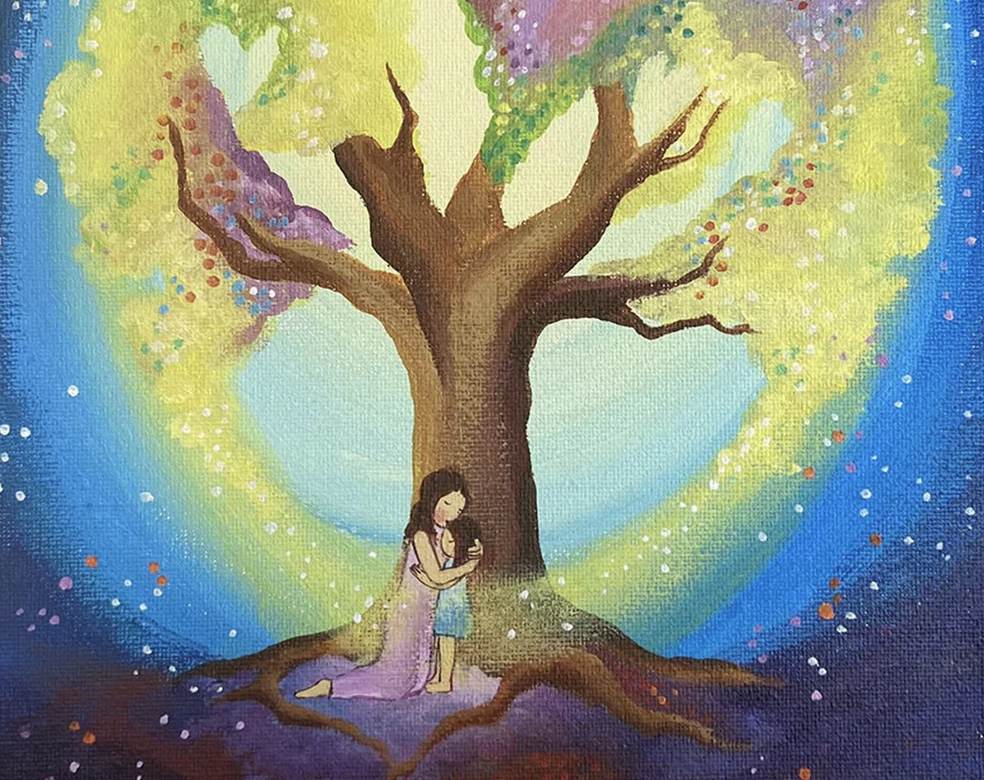
Meeting Mother Teresa and my search for the divine feminine
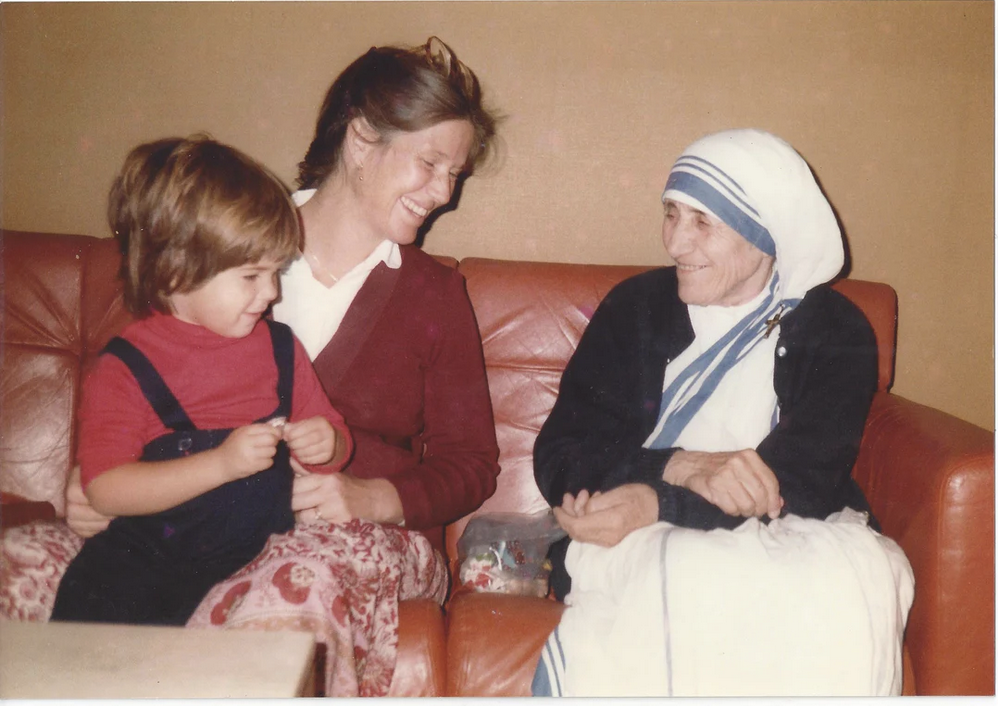
This picture has been with me for as long as I remember and for as long as I remember, I have been yearning for the divine. It hung in my room as a child, and I carried it with me to all of the places I have lived as an adult. But only recently have I realized its miraculous nature. I feel blessed to have had a moment with a Saint and a woman who devoted her life to serving the poorest of the poor, who stood courageously for what she knew was right. She is an inspiration for me.
When I was in 6th grade, my mother came to speak at my school about her experience volunteering with the Missionaries of Charity in Hong Kong. She told our class the story of a woman who was so poor that she lived in a closet and had barely any possessions. When my mother visited her, she gifted my mother an apple. This touched my mother deeply as she realized the true meaning and sacrifice of giving. Not giving what is comfortable, what you don’t need, but giving your only sustenance to a wealthy foreigner who could have bought dozens of apples. It did not make any rational sense for the mind but it did for the heart for the heart only knows love.
Another anecdote my mother recounted was that she was nervous about me handing out sandwiches to lepers and men with tuberculosis on the streets outside the convent. The sisters reassured her, promising that I would be protected.
I have vivid memories of standing in my elementary school playground praying the rosary. I would silently repeat the prayers in my mind as I moved the beads through my fingers, my rosary in my pocket. Nobody knew I was praying the rosary, I don’t think my parents knew either. I also remember reading about the lives of Saint Bernadette and Saint Therese of Lisieux when I was about 9 years old and holding them as my ideals. I wanted to live a life like that, I wanted to dedicate my life to God, I considered the possibility of becoming a nun. Every night, before falling asleep I would pray the Our Father and Hail Mary. I had a beautiful card above my bed of the statue of our Lady of the Miraculous Medal from Rue du Bac.
After 5th grade, my parents moved me from Public School to a Catholic school. My mystical christianity soon became tainted by the sermons about sin and guilt and the mandatory weekly confessions. I still was fascinated by the magic of prayer and how I felt when I reflected on the stories of the Marian Apparitions and the lives of the saints but I grew disillusioned with the rules and the rote repetition of the prayers, of sitting down/ standing up at exactly the same times. Something huge was missing. Where was the powerful mystical experience, where was the devotion and love?
As part of our school, each year, we took a pilgrimage to a different holy place in France. We went to Lourdes and Rome and Lisieux and stayed in monasteries. I vividly remember walking down the halls of a monastery somewhere in a beautiful part of France and sensing in my whole body that I had lived in a monastery before. It felt like home. I loved the little room we stayed in and I imagined my life as a nun, the steadiness, the rhythm and the prayerful existence I could feel all around me. We would wake up at 4am and walk across the grass to the chapel to attend mass. This was the first time in my life I had intentionally woken up early and prayed in the early morning, the “amrit vela” as it’s known in the east, the time of nectar. I felt entranced by the sensation of being in a room lit with candlelight, and surrounded by the voices of humans praying and singing together. I was deeply moved.
My family would go to the Episcopal Church in Paris for Easter and Christmas. My father grew up Catholic and my mother protestand. I was baptized by a woman in a prostestant church in Hong Kong. I received my 1st communion and Confirmation in the Catholic Church in Paris.
My confirmation was another powerful moment, I remember feeling out of my body when Cardinal Jean-Marie Lustiger, dressed in red robes, approached me. He had a kind powerful and loving presence and as he anointed me I felt that same way I felt in the bath at Lourdes. This ecstasy and bliss, like I was stepping out of time. One of our classmates had an angelic voice and sang the Ave Maria. As I listened to her sing, my heart collapsed into softness and tears welled up in my eyes. It was the most beautiful sound I had ever heard.
I remember our trip to Rome, visiting the Vatican, the Sistine Chapel and numerous magnificent churches but what moved me the most was my time in Lourdes. In 2000, there was a big Jublile during which 80,000 catholic youth did a pilgrimage to Lourdes. It was amazing to walk on the streets of Lourdes surrounded by thousands of people singing and praying together and holding the flags of their respective countries and schools, all united by our faith. As I was familiar with the story of Bernadette Soubirous, I was very eager to experience the site of the apparition. We were taken to a changing room and given something that looked like a white sheet to me, we were to wrap it around ourselves and step into another room. I don’t remember knowing what this was about or maybe I wasn’t paying attention and chatting with my friends, we followed along.
All of a sudden, I found myself in a room that looked like a cave, natural grey stone walls, it felt ancient, like we could have stepped into biblical times. There were a few steps up and a woman on either side of the steps. They indicated that I was to hold on to each of their arms as they led me up these steps. The steps then flattened at the top of what looked like a big bathtub carved into the stone. They kept guiding me forward, there were steps that descended into the water. I don’t remember them speaking, there was a powerful, mystical silence. The water was cold but it didn’t bother me, I stepped down, deeper and deeper until they guided me to fully immerse myself. When I emerged out of the water, I felt changed. It was cold but it wasn’t just that, I felt alive, elated, it is a sensation that has never left me. I looked up, I felt like I was in an altered state. I stepped down the steps and back to earth. I didn’t want to speak to anyone so I discreetly got dressed and eclipsed myself. I felt like my prayer for a mystical experience had been granted. I experienced something I had never experienced before, it felt like being reborn, like a quantum shift.
I don’t remember much else about that trip other than sitting in a circle with a group of maybe 8 fellow students and a “guide”. I remember asking questions, but none of the answers resonated with me, the depth of my experience didn’t match the intellectual explanations about sin and heaven and hell. I wanted to feel, not be told. The priests and nuns in our school did not seem to lead joyful and inspired lives, they seemed weighed down by “shoulds” and heaviness. Where was the bliss and love?
The trip to Lourdes would be my departure from formal Christianity.
I left Paris and came to the US to attend college. All of this seemed far away. There were fascinating classes, fun friends, parties, exploration of potential careers. I felt I left all those experiences behind in France and would continue my search by taking a better and different path. So like many, I looked East. After graduating, I found yoga, I was hooked. It felt so good to be in the body, it felt like praying with my body. And I loved the mystery of the sanskrit chants and the activism. I stopped eating meat, I read and learned as much as I could. I then trained to be a Kundalini Yoga teacher, I dove in deep, there were countless yoga kriyas and meditations I could learn and teach. I would help others find the light within. I felt “high” many times during classes, the intense breathwork and the repetitive movements helped ease the existential angst I felt. I wanted this to be it. I wanted to have found the “right” practice. For 13 years, I taught and learned about yoga, meditation, mindfulness, energy healing, shamanic wisdom, journeying. It “worked” yet I was still searching. It never settled in deeply, I didn’t have that moment of being fully at home. So I thought, I have to learn to love and accept myself, the answers are all within. God is within and all the wisdom is within. Yet I craved guidance, someone I could trust. I instinctively could not follow or fully trust the “Guru” of Kundalini Yoga and it turns out, for good reason. A few months ago, hundreds of allegations came out against him. That myth crumbled and even though I always had held back from considering him my teacher, it is difficult to process, there is grieving and anger and it will take time. I knew it was no longer my path, but I didn’t know where to turn. I asked for guidance and waited.
A few weeks ago, I was taking a zoom class about family constellations and the teacher was wearing a black sweater with the roaring face of a panther on it and a necklace with a small gold medal. I immediately recognized this medal, the miraculous medal from Rue du Bac in Paris. I had this same medal, and my parents had them too and I remember being deeply moved by my visit to the church. I went to search for it in my jewelry boxes. I found it, I was deeply moved to be holding it and put it on a chain that hangs right at my solar plexus. I have been wearing it every day since. I gaze down at it, and hold it in my hands. I feel Our Lady’s strength and support carrying me through the day. I ordered books about Mother Mary’s apparitions, about the Gospel of Mary Magdalene, about the Goddess and then one day I found The Way of the Rose. My heart reacted right away upon seeing the cover. I bought the audiobook and listened, fascinated. My heart felt full, like I was coming home after all these years. Sometimes I had to pause the audiobook because the strength of the resonance was so strong I had to take a few breaths. It felt like coming home after a long journey. Back to where I started but with a completely new perspective.
Perditta and Clark had filled in the blanks, everything I had felt was missing, the love for our Mother Earth and our Divine Mother. It’s not one or the other. We can’t live for a heaven that will come when our bodies go back to the earth. The way to experience the divine is right here, right now, in our beautiful glorious bodies.
Healing Your Inner Child: Understanding Your Parents and Breaking Generational Patterns
In our journey of self-discovery and personal growth, one of the most challenging yet rewarding paths is understanding and healing our relationship with our parents. This process is crucial for inner child healing and breaking generational patterns that may have caused pain or dysfunction in our lives.
Our perception of reality, especially concerning our childhood and parents, is subjective and evolves over time. The lens through which we view our past may have once protected us, but as adults, it's time to adjust this lens for a clearer, more compassionate view.
As we delve deeper into our memories and family dynamics, we enter what I call "the realm of the parents" in our inner journey. This exploration requires us to spend time in the shadows of our memories, allowing hazy aspects to clarify and reveal new information. By integrating these less familiar areas of our perception, we begin to see our parents with fresh eyes.
It's important to remember that our parents, like us, are complex beings shaped by their own upbringing and cultural context. They too are on an evolving journey, often unconsciously passing down generational patterns. This understanding doesn't excuse abusive or neglectful behavior, but it helps us recognize that their parenting style wasn't a personal attack; they likely would have treated any child similarly.
A crucial step in this healing process is accepting that our parents may never fully see things from our perspective or empathize with our experiences. They may never change their views due to their own unhealed wounds and ingrained perceptions. Instead of waiting for them to change, we can celebrate the clarity we've gained and move forward with a more compassionate understanding of ourselves and our past.
Our hero's journey begins before our first breath, in the miraculous fusion of two lineages. From the moment of conception, we become living embodiments of our ancestral heritage, carrying forward the stories, strengths, and challenges of those who came before us. Understanding this context allows us to approach our family history with humility and compassion.
By exploring our family dynamics, we open ourselves to a more nuanced understanding of our origins. This exploration isn't about assigning blame, but about gaining insight into the complex tapestry of influences that have shaped us. By doing so, we empower ourselves to break harmful cycles, heal generational wounds, and craft our own unique path forward.
Exercise: Adjusting Your Lens
Find a quiet space and take a few deep breaths to center yourself.
Visualize a specific memory involving one or both of your parents.
Imagine you're looking at this memory through a camera lens.
Slowly adjust the focus, zooming in and out. What new details do you notice?
Now, try to view the memory from your parent's perspective. What might they have been feeling or thinking?
Journal about any new insights or emotions that arise from this exercise.
Prompts for Further Reflection:
What generational patterns can you identify in your family? How have these affected you?
In what ways have you gained clarity about your childhood experiences as an adult?
How can you honor your parents' role in your life while still acknowledging any pain or difficulties?
Remember, healing your relationship with your parents is a journey, not a destination. Be patient and kind to yourself as you navigate this path of inner child healing and personal growth.
Want to learn more, check out my book Reclaiming Your Inner Child.